
The BJP may win more seats in the February 5 assembly election, but not enough to trump AAP, notes Ramesh Menon.

Investors need to carefully assess country-specific risks. 'This is especially true of a market that is less transparent than the US.'

'Studying was never an important part of our life, surviving was.'

'Till the BJP does not understand Kejriwal they cannot win Delhi.'

For those looking for more affordable options, purchasing an under-construction property could be a smart move, as these generally cost less than ready-to-move-in properties.

Many senior citizens 'underestimate the impact of inflation, taxation, health-related expenses, and the heavy premium they will have to pay on health insurance.'

A bill will be brought in the assembly during the ongoing session, possibly this week according to sources in the cabinet.

India's economy is likely to grow by 6.5 per cent in the current and the next financial year, an EY report said, attributing lower than anticipated expansion in the September quarter to fall in private consumption expenditure and gross fixed capital formation. Real GDP growth eased to a seven-quarter low of 5.4 per cent in July-September -- the second quarter of the current 2024-25 fiscal year.

Be it poor, middle class, upper middle class or rich, every individual who is 70 years and above is eligible for getting Ayushman card and will receive free treatment up to Rs 5 lakh at any of the AB PMJAY empanelled hospitals once the expanded scheme gets launched.

Experts say you should be certain of living in a city and locality for a long time before purchasing a home.

Updated new base years for national accounts and other macro-indicators are expected to come into effect from January-February 2026, coinciding with the first and second advance estimates of national income for FY26, senior official sources aware of the development told Business Standard. "The statistics ministry set up the Advisory Committee on National Accounts Statistics (ACNAS) earlier this week. "It will advise on the base year for GDP (gross domestic product) and its alignment with other macro-indicators.

Deloitte India on Friday said it estimates India's GDP growth at 6.6 per cent in the current fiscal helped by consumption expenditure, exports rebound and capital flows. In its India's economic outlook report, Deloitte said the rapid growth of the middle-income class has led to rising purchasing power and even created demand for premium luxury products and services. With the expectation that the number of middle-to-high-income segments will be one in two households by 2030/31, up from one in four currently, we believe this trend will likely become further amplified, driving overall private consumer expenditure growth, it said.

Feature for feature, bank FDs are indeed better than debt funds today, mainly thanks to Ms Sitharaman, notes Debashis Basu.

'They take care of the problem: How can I ensure my child's education and other goals are not compromised, even if I am not around?'

'If you are watching cricket and don't want to leave the screen, you could check the menu and order through Zomato (or any other app) from a small part of your screen. That is what we are working towards.'

Workplaces of 2025 will be defined by a deep focus on people-first values, inclusivity, and sustainable growth, foresees Sonica Aron, founder of Marching Sheep.

Looking under the hood, I see India on the terrible, but commonplace, road to prosperity failure, warns Rathin Roy.

It will be the second Budget of the Modi 3.0 government and eighth straight Budget for Nirmala Sitharaman, rare in Indian polity.

A change in the desire to buy consumer durables is perhaps the most important indicator of an economy changing direction, explains Mahesh Vyas.

The Budget proposals are expected to boost the fortunes of consumer goods and fast-moving consumer goods companies, which have been struggling with poor consumer demand for more than a year. The Budget announcements, such as the increase in standard deduction by Rs 25,000 for income-tax payers and slab revisions, will put more money in their hands, boosting consumer demand. Private consumption is also likely to benefit from a new scheme to offer internships to 10 million youths in the country's top 500 companies.

Urban men lost more jobs than women during the second wave of COVID-19, implying a complete loss of livelihood for millions of households, according to the Centre for Monitoring Indian Economy (CMIE). The most disproportionate loss of jobs because of the first wave of COVID-19 was among urban women, CMIE's MD and CEO Mahesh Vyas said in his analysis. He said urban women account for about three per cent of total employment, but they accounted for 39 per cent of total job losses in the first wave of the pandemic.

'The linking of Aadhaar to births and deaths will revive the debate around citizenship.'

According to the report, financial assets of the Indian households are predominantly in the form of bank deposits, followed by life insurance - a pattern that got disrupted after note ban

The decline is attributed to lower salary growth and a rise in households' financial liabilities.

The share of women employed in regular salaried jobs in urban India hit a fresh low in the January-March quarter (Q4) of 2023-24 (FY24). In the same period, the share of women engaged in self-employment went up. An analysis of the latest quarterly Periodic Labour Force Survey (PLFS) data showed the share of women in regular wage work among all employed women stood at 52.3 per cent in Q4FY24, down from 53 per cent in the previous quarter.

An analysis by the Securities and Exchange Board of India (Sebi) has revealed that retail traders remain at the wrong end of the stick when it comes to equity derivatives trading. About 93 per cent of them incurred an average loss of Rs 2 lakh (per trader) during the last three financial years. The new report highlights an increase in the loss-making individual investors in futures and options (F&O) to 91.1 per cent in FY24 compared to 89 per cent in FY22.

The ministry of finance is likely to assume crude oil price to remain within $85 per barrel while estimating subsidies for the Interim Budget 2024-25 (FY25), to be presented on February 1. Brent crude prices moved up on Thursday, ending at $78.9 per barrel. Crude oil and cooking gas prices, which move in tandem, impact fertiliser and cooking gas subsidies, constituting 53 per cent of the government's total subsidies.

Adopting overly aggressive strategies without considering risk could lead to significant losses during the next downturn.

India-born American residents, numbering over 1.5 million, are the best educated among all the foreign born communities in the US and are also the highest earners in the country, latest census has revealed.
'As long as economic growth remains steady, creating jobs and generating stable incomes, the rise in home loans should not create problems.' 'If the growth trajectory changes course over the medium term and interest rates rise along with inflation, the expanding trend in home loans may not sustain.'

'Subject to any worldwide economic collapse.'

Growth in credit card outstanding has been the fastest compared to other personal loan segments

For women, it is important to build an emergency fund and a financial independence fund independent of the couple's joint goals and plans.

Over 10 million Indians have lost their jobs because of the second wave of COVID-19, and around 97 per cent of households' incomes have declined since the beginning of the pandemic last year, Centre for Monitoring Indian Economy (CMIE) chief executive Mahesh Vyas said on Monday. The unemployment rate measured by the think-tank is expected to come at 12 per cent at the end of May as against 8 per cent in April, Vyas told PTI, adding this signifies that about 10 million or 1 crore Indians have lost jobs in this period. Stating that the main reason for the job losses is "mainly the second wave" of COVID-19 infections, Vyas said, "As the economy opens up, part of the problem will be solved but not entirely."

Questions on the efficacy of the government's drive towards filing of more returns by individuals and on whether raising tax exemption levels has led to reduced compliance in filing of returns by those who go out of the tax net, says A K Bhattacharya.
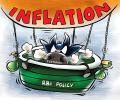
Amid a debate on the basis of a monetary policy stance, one may be curious enough to know how non-food retail inflation has behaved over the years in India. Let the eager souls catch a glimpse of facts. In the past 10 years, non-food inflation came down below 4 per cent on two occasions - pre-Covid period of 2019-20 and now in the first four months of the current financial year (FY25).

'One of the big findings is that younger men seem to have shifted towards the Republican Party.' 'In 2020, about 23% of younger men said they would vote Trump.' 'Now that number is 48%.' 'It is like a 25 point shift, and you don't actually see shifts that big in surveys.'

India's housing sector is witnessing probably the "biggest boom" in the last one and half decade driven by various factors such as affordability and customers aspiration to own homes, HDFC Capital Advisors Managing Director and CEO Vipul Roongta said on Tuesday. Addressing a real estate summit organised by FICCI, he noted that the residential real estate segment has revived strongly after going through a lot of pain due to new realty law RERA and demonetisation. "In the last one and half decade, I think this is probably the biggest boom I am personally seeing as an organisation on the residential segment, whether it is affordable mid-income and premium housing properties," said Roongta, who is also co-chairman, FICCI Real Estate Committee.

The banking regulator was uncomfortable with the runaway pace at which consumer credit was growing.
New filers reported an average income, in many cases, close to the income tax threshold of Rs 250,000, limiting the early revenue impact.
 © 2026 Rediff.com - Advertise with us - Disclaimer - Privacy Policy - Sitemap - Feedback - About us - Terms of use - Grievances